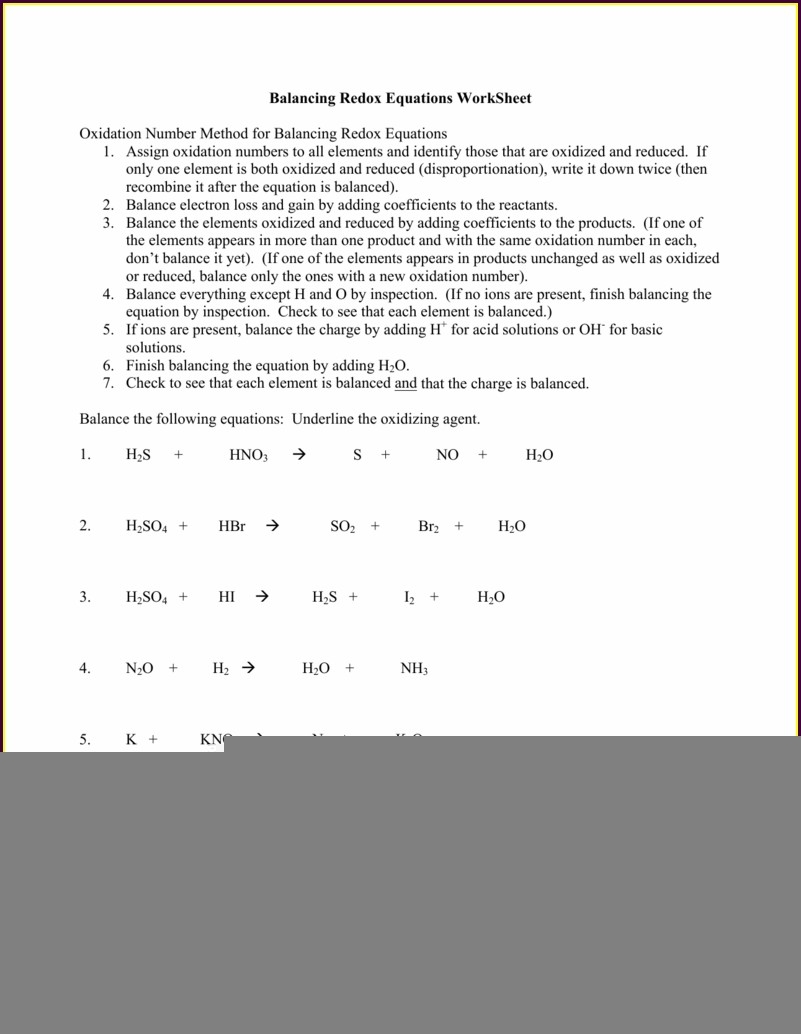
Assigning oxidation numbers is an important skill in chemistry that helps us determine the charge of an atom within a compound. It is essential for balancing chemical equations and understanding the behavior of elements in reactions. To practice this skill, students are often given worksheets with various compounds to assign oxidation numbers to each element.
These worksheets can be challenging, as they require students to understand the rules for assigning oxidation numbers and apply them correctly to different elements. Having an answer key to refer to can be very helpful in checking their work and correcting any mistakes.
Answer Key:
Below is an example of an answer key for assigning oxidation numbers worksheet:
1. HClO
Hydrogen (H) = +1
Chlorine (Cl) = +1
Oxygen (O) = -2
2. KMnO4
Potassium (K) = +1
Manganese (Mn) = +7
Oxygen (O) = -2
…
3. Fe2O3
Iron (Fe) = +3
Oxygen (O) = -2
…
4. H2SO4
Hydrogen (H) = +1
Sulfur (S) = +6
Oxygen (O) = -2
…
5. NaCl
Sodium (Na) = +1
Chlorine (Cl) = -1
…
These answer keys provide the correct oxidation numbers for each element in the given compounds, helping students verify their solutions and learn from any errors they may have made.
Practicing with assigning oxidation numbers worksheets and using answer keys is a great way for students to improve their understanding of this fundamental concept in chemistry. With consistent practice, students can become more proficient in assigning oxidation numbers and applying them in various chemical reactions.
In conclusion, having an answer key for assigning oxidation numbers worksheets is a valuable resource for students to check their work and reinforce their understanding of this important concept in chemistry. By using answer keys, students can gain confidence in their ability to assign oxidation numbers accurately and apply them effectively in chemical reactions.